Monday, January 24, 2011

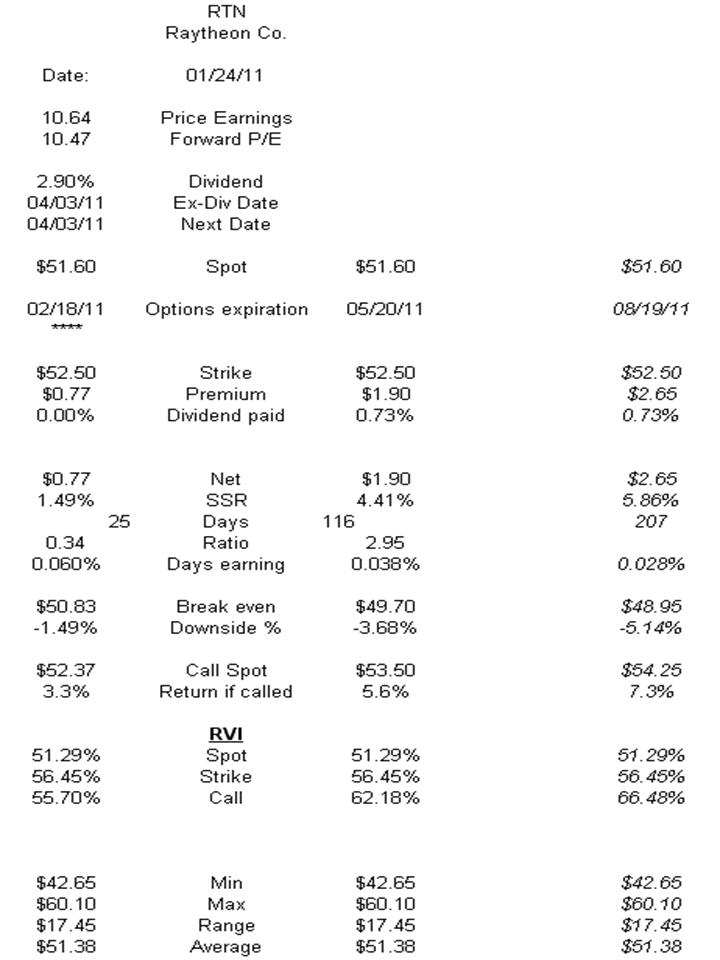
012411 - BMY, COP, CVX, HRB, INTC, JNJ, KO, LO, MCD, MSFT, PEP, PFE, PG, PM, RTN, T, TEF, TM & TOT

This analysis was done throughout the day of 01/24/11.
The VIX declined steadily throughout the day closing down 4.44% from 18347 to 17.65.
The S&P 500 was up 0.6% for the day closing at 1,291.

The stocks were reviewed by presented in an article written by Nicholas Southwick Levis published on January 23, 2011, at SeekingAlpha.com entitled, "20 Relatively Safe and Cheap Dividend Stocks for Income Investors".

Ashford Hospitality Trust, a REIT was not included in our analysis as there are is no declared dividend, P/E's or other matrix we like to look readily available. Furthermore, we really do not care for REITS and are very picky about the ones we will own. This particular REIT appears to be dominated by hospitality, a sector we do not really like in this current economic environment.

LO is a stock that was much discussed in the comments section of the article. We like the profile of the stock and we like the sector as well.


We provided the #1-3 ranking of the group for SSR, Days Earnings and Overall combination. HRB,

Symbol Name

BMY Bristol-Myers Squibb Company - Overall #2 tied/SSR #1 - The dividend impact is huge as the dividend at 5.1%. The RVI's are just above mid range. There is a lot to like about this stock based on its statistical profile.

COP ConocoPhillips - Overall #2 tied/Days Earnings #2 - RVI's are at the top of the range, that is the bad news. Each scenario earns the dividend. We like this sector.
CVX Chevron Corp. - Like COP RVI's are at the top of the range, each scenario earns the dividend and we like the sector.

HRB H&R Block, Inc. - (NEW) - Overall #1/Days Earnings #1 - This is our first look at this stock. The volatility's pricing is strong at the near dates especially into the dividend. RVI's are low and the stock has been on a major down trend. It is off its October low of $10/ and the near term trend and sentiment is positive, we suggest you do your research extra careful with this stock.

INTC Intel Corporation - We have been big fans of Intel for a long time as far as our strategy goes. RVI's are mid range and each scenario earns the dividend.

JNJ Johnson & Johnson - Another stock we like in a sector we like. The overall profile is nothing to make a fuss over, but JNJ is a Bedrock stock.

KO The Coca-Cola Company Common - RVI's are high and the dividend is paid in the later dates.

LO Lorillard Inc - Days Earning #3 - RVI's are low and the stock has been hammered as a response to their recent acquisition. We like the sector but are not crazy about diversification efforts. Their purchases are ok, but we have seen too many "sin" companies diversify with poor results outside their core business.

MCD McDonald's Corp - RVI's are high but not outrageous. We like MCD and believe it is a well run company. The dividend makes the far date attractive.

MSFT Microsoft - RVI's are high mid range. It is hard not to like MSFT and we have been active in the stock for quite a while.

PEP Pepsico, Inc SSR #3 - RVI's are high, across the board each date pays around 0.02%/day.

PFE Pfizer, Inc - As noted the difference between the $18 and $19 strikes was a few pennies. We chose to use the $18 in the money's in our analysis thus eliminating the upside/stock appreciation. RVI's are high.

PG The Procter & Gamble Company - Another company we like for many reasons and a Bedrock stock. RVI's are at and above 100%.

PM Phillip Morris SSR #2 - Unlike it's competitor LO, it has gained in value and has high RVI's. We have liked the stock for a long time and continue to like it.

RTN Raytheon Co. (NEW) - Despite the fact they make really neat things, RVI's are low, the sector is strong and the stock has a nice return profile.

T AT&T - RVI's are high, however we have and continue to like this stock in this sector. As noted the $28 strike calls provided a few more pennies in income than the $29 strike. We chose to sell the "in the money" calls.

TEF Telefonica SA Common (NEW) - RVI's are high, the rest of the profile is ok.

TM Toyota Motor Corp. (NEW) - RVI's are mid range and the overall profile is not too exciting.

TOT Total S.A. (NEW)- RVI's are very high and the overall profile is not too exciting for a sector we like.


*Note: the tables shown are embedded .jpg files. This means that you can: 1) double left click them with your mouse to enlarge them, or 2) right click them with your mouse and choose to open them in a new window or tab, print, save, etc.
As with everything we post, we may or may not have the stock and/or strategy in place in any one of our portfolios or may add it at any time. We do not make any buy or sell recommendations. We provide basic analytical research, some short commentary of the results and encourage you to do your own thorough due diligence prior to any purchase or sale.




Thursday, January 20, 2011

Hey Moe III (and final)


Final not to be continued.

One of our more communicative readers questioned this 3 part series on the economy.
He wanted to know why we would take on a controversial subject like stimulus and government actions and policy. After all we are dedicated to providing such good investment strategy and tactics. I began my answer with a simple question, did he agree with our analysis to date or not. He said he agreed and also learned a lot. Well I replied our goal is to inform and educate our readers. Government policy can have a really big impact on the markets and as investors it is important to understand this and the implications of the actions of the government. If you compare the available types of invest-able instruments over the past few decades you will notice many have disappeared and many are relatively new. This does not mean they were bad and the new ones are good it just means that markets are dynamic and tax implications and regulatory oversight can have a big impact. Estate taxes, retirement plans, gains tax, loss treatment, etc., are all addressed by government policy. It was once explained to me that the role of corporate management is to make profits and avoid paying taxes on the profits. I think estate planning is no different. The trouble is that the planners are always planning for an environment that is unknown. Tell me what the tax rate will be on retirement savings, the age that the savings can be tapped for someone retiring in 35 years and I’ll be shocked if you are right. This is a dilemma that 30 year olds are facing as they enter into their asset building years. Bottom line government policies do impact the investment markets.

How can a Government stimulate an economy?


First step is A) provide incentives for growth.

Second step is B) stop spending money unnecessarily.


STEP A – Provide incentives for GROWTH:


1) Establish a stable environment for investing
2) Allow for a liquid market to exist
3) Give companies and investors an incentive to invest
4) Stop meddling on the free markets


1) Establish a stable environment for investing
Provide a tax system that is known. This was somewhat accomplished in December of 2010. The fact that the prior decades tax rules had expired and there was no clear solution for the future helped the market decline.

2) Allow for a liquid market to exist – liquidity is the grease for fluid market operations. The lower the taxes, stamps, fees, reporting, restrictions and the higher the convertibility and openness of transactions the more liquid the market. This applies to internal and external capital. You can have the most liquid domestic investment markets but if you do not allow capital to flow into and out of your currency/local market you cripple the overall liquidity. Countries that have transaction restrictions, block their currencies or tax transactions the less liquid their markets. The countries that are at risk for this also suffer liquidity constraints. Keep the markets and flows free.

3) Give a) investors and b) companies an incentive to invest – the single most important element.

a) Stable governments and regulations are key. Keep legislators at bay and the regulators focused on letting the markets operate freely and efficiently. Develop policies to reduce cash hording. When real rates are high, lower them. Negative interest rates are not unheard of, they are just not familiar. Negative real rates are not unusual, they are just not recognized. Charge cash hoarders to keep money in savings. Why not? If it costs money to keep savings, savers will have to decide if they want to save or deploy their money elsewhere.

b) Incentivize growth. Government does not create jobs, business does. Provide incentives for companies to grow. Payroll taxes are the single most important indicator of job creation. The higher the payroll tax receipts the lower the unemployment rate. Governments should reward companies for increasing payroll taxes. Allow companies to offset portions of new payroll dollars against taxes. Why not? If an unemployed worker is earning $15,000 in benefits, why not allow a hiring company this amount in benefit in the form of a tax credit? If an unemployed worker is hired with a salary of $75,000 a year and paying 20% in gross taxes (ie: $15,000) the result is $60,000 in additional multiplier. Not to mention less of a strain on the unemployment cash pool. The corporate tax offset of $15,000 has a zero sum impact as it opposes the income tax payments. Did we mention the unemployment cash pool relief? Think there is a stimulative impact? LOOK AT THE GRAPHS BELOW…….


Image: Deutsche Bank (Read more: http://www.businessinsider.com/corporate-tax-receipts-2010-9#ixzz1BY208vbD )

(Via Deutsche Bank, Corporate tax receipts suggest businesses still expanding, Joseph LaVorgna, 27 September 2010 http://www.businessinsider.com/corporate-tax-receipts-2010-9 )

Link http://bonddad.blogspot.com/2010/10/closer-look-at-withholding-tax-receipts.html


4) Stop medaling on the free markets – no more bailouts! The markets need to trade based on “clearing prices”. A clearing price is: “The price assigned to an asset after buyers have completed the bid and ask process. The clearing price represents the highest negotiated price that the buyer is willing to pay and the lowest price that the seller is willing to take.” (from InvestorWords.com). A company’s stock price should reflect the value of a company. If company is operated poorly or exceptionally, its stock price should reflect its strength. Keep government out of the business of business. A perfect example, “The Department of Justice investigates roughly 100 price-fixing cases each year. In many cases, these investigations result in indictments. Those cases would, if justified, result in lower prices for consumers. But, economist Michael F. Sproul, in an examination of 25 price-fixing cases for which adequate data were available, found that prices actually rose in the four years following most indictments.” (Principals of Mircoeconomics, 16.1. Antitrust Laws and Their Imterperation” Rittenberg and Tregarthen http://www.web-books.com/eLibrary/ON/B0/B63/080MB63.html).

Dr. Sproul is a brilliant economist as well as a wonderful person and proves thee fallacy of a topic that belongs on myth busters. Let’s keep government where it belongs and out of the business of business.

The recent bailout of some of the auto industry is an example of meddling. “President George W. Bush's administration, only weeks before leaving office, gave GM and Chrysler $17.4 billion in loans after legislation to speed loans to the companies failed in Congress. The Dec. 19, 2008, terms signed by GM and Chrysler required them to reduce their debt levels, negotiate wage and benefit cuts for auto workers and submit detailed restructuring plans by Feb. 17, 2009, showing a path to "long-term viability, international competitiveness and energy efficiency." (GM-Chrysler Bailout: Was It A Blank Check? KEN THOMAS | 09/20/10 The Huffington Post).

“required them to reduce their debt levels, negotiate wage and benefit cuts for auto workers”

Kind of like the Latin American thing discussed in Hey Moe I - all over again – do as I say not as I do

Remember that other American auto manufacturer Ford? They did not receiver bailout money and continue to operate in this un level playing field. The issue is that the government bailed out the competitors that failed to be competitive. Ford miraculously survived without subsidies. GM received about 20-25% of the value of F and a bankruptcy from the US Government. What happened to F? It’s stock price dove from $5 to $1.5 and recovered to $17.5. The markets love a winner! And by the way, while in addition to celebrating it’s first slug of US bailout money GM executives had to make a quick exit from the US Government bail out party to go to China to celebrate the opening of their 8th manufacturing plant.


B) Second step is STOP SPENDING MONEY UNNECESSARILY.

Also know as budgeting within means. If income is $1.00 do not spend $2.00. Deficit control is very important. In Hey MOE I, we mentioned Latin America and the turn about after years of lecturing. Confidence in investors is important and just with companies, governments need to keep their fiscal houses in order. Step back from the debt trough and behave within your means!” We are advocating a balanced budget amendment, just fiscal discipline. At times it is necessary to exceed income and times it is necessary to save.

There is a distinct difference between spending and investing. We believe investing is what governments need to do. If money is spend there is no tangible benefit, if it is invested there is a benefit. The example would be spending money on a big party (spending) or investing money in better roads (investing).
Dick Army and Matt Kibbe wrote an Opinion article published in the Wall Street Journal on January 19, 2011, entitled, “What Congress Should Cut Let's scrap the Departments of Commerce and Housing and Urban Development, end farm subsidies, and end urban mass transit grants, for starters.”
This article outlines some pretty specific targets that they justify eliminating. It is aggressive but unrealistic. The main point is that it offers some advice and offers up some sacred and protected departments and programs. (Link to article : http://online.wsj.com/article/SB10001424052748703779704576073750780454850.html?mod=ITP_opinion_0#articleTabs%3Darticle).

In summary:

The solution lies in fiscal and monetary policies. Let the markets operate, support the economy and keep the finances in order.

Saturday, January 1, 2011

Hey Moe II


What is Stimulus?

Webster Defines Stimulus as:
stim•u•lus
noun \ˈstim-yə-ləs\
plural stim•u•li\-ˌlī, -ˌlē\
Definition of STIMULUS
: something that rouses or incites to activity: as a : incentive b : stimulant 1 c : an agent (as an environmental change) that directly influences the activity of a living organism or one of its parts (as by exciting a sensory organ or evoking muscular contraction or glandular secretion)


Seems like we have been on a global stimulus rage for the past 4 years:

Gross debt as percentage of GDP


Sources: IMF, World Economic Outlook (emerging market economies); OECD, Economic Outlook (advanced economies)
Yep that is about a 24% increase for the period, with the exception of Latin America.
Weren’t they, those folks in Latin America supposed to implode?
Seems like LatAm got their religion after all the years of brow beating from the developed nations just in time to watch the, “Do as I say Not as I do” implode.


By the way, 9 of the above countries are part of the EU single currency – Can anyone say Danger, Danger!


Things are not so wundaba in Frankfort at the European Central Bank.


Europe's sovereign-debt crisis is set to continue into 2011
The sovereign-debt crisis in Europe appears poised to continue into the new year, as Greece and Portugal face possible downgrades to their credit ratings and Spain is forced to pay more to issue debt. China has urged European leaders to show that they can contain the region's fiscal woes and rectify the situation in a timely manner. Reuters (21 Dec.)

At least we are not the only ones concerned with the ballooning debt.


 Citigroup urges the EU to resolve the sovereign-debt crisis
Willem Buiter, chief economist at Citigroup, said the European Central Bank and EU governments are playing a "game of chicken," paralyzing the eurozone. Citigroup warned that unless EU leaders launch a credible response to the region's sovereign-debt crisis, more banks will collapse and governments will default. "The market is not going to wait until March for the EU authorities to get their act together," Buiter said. "We could have several sovereign states and banks going under. They are being far too casual." Telegraph (London) (21 Dec.)


Aren’t these the guys who were essentially bankrupt before the government handed them $25 billion along with $300 billion in loan guarantees?
Seems like their experience has given them the inside track on these types of things – comforting is it not?


Feeling uneasy - you soon will - read on.......


HERE IS ONE REALLY BIG PROBLEM:


PEOPLE: 308,745,538
DEBT: $13,868,461,000,000

The debt is $44,918.74/per person
The medium household income is $46,346
.


On October 19, 2010, the Bureau of Labor Statistics (BLS) reported, “Median weekly earnings of the nation's 101.4 million full-time wage and salary workers were $740 in the third quarter of 2010 (not seasonally adjusted), the
U.S. Bureau of Labor Statistics reported today. This was 0.3 percent higher
than a year earlier, compared with a gain of 1.2 percent in the Consumer Price
Index for All Urban Consumers (CPI-U) over the same period.”

This increase is a relief! ?

Trying to make our economy grow with this much debt is like a couch potato who eats extra helpings of cheesy fries with a bucket of beer and ½ a chocolate cake 4 times a day run a marathon in under 3 hours
– they can try but will fail –
Listen closely and you will hear the huffing and puffing of our economy as it prepares for the inevitable – collapse……

I had a simple rule concerning credit that applied to credit cards – If you only buy something on credit if it will be there the day the credit card statement arrives – in other words food, meals, fuel, etc are consumables – clothes, white goods, etc are durables. When debt is incurred to spending on consumption it is bad debt, when it is for investment it is good debt.
Another example is related to muni debt. I will only buy muni debt if it is backed by something other than fiat or the ability to tax. Full faith and credit is good and all but revenue production through fees is better. I will take a bond with a primary backing by a sanitary facility, toll road, power plant, then backed by fiat any day of the week. These bonds represent investment and as our readers know we like investing.

The second point is in this vein is that we all know government does not create jobs. Government jobs are non productive. They add nothing to the economy. The reason is simple, the government provided services that are regulated. These jobs are “legislated” or created by law not demand for goods and services. The salaries paid are generated by tax levies or operating fees. I’m not saying that government jobs are all un-necessary. A simple rule is to look at any government job and think of the consequences that would result if no one did that job. Is there a private sector replacement for that job? If there is no private sector replacement it is not necessary. Examples are education, there are public and private schools, education is necessary but not necessarily something government should provide. Most parents of school age children would opt for free private school. This simply means they believe that private education is better than public education. Police forces can be replicated by security companies, there are public and private utilities etc, etc. One thing that has recently come to light is that government wages are higher than their private sector counterparts. Curious isn’t it? Why does a non competitive employer (ie: one who operates as a pure monopoly) have to pay so much with unemployment so high? Keep in mind that most public sector employees are unionized then you must ask yourself why?


What happens when you spend more than you make? You do into debt!
For the government this means borrowing through the Treasury.

The following is a list of the Top 10 Foreign Owners of U.S. Treasury Securities as listed by the U.S. Treasury (Major Foreign holders of U.S. Treasury Securities , U.S. Treasury Department.)
In BILLION$ of $’s holdings at the end of 9/2010 1
% foreign
Country $ value Held % of total


Total US Debt $13,561


Department of the Treasury/Federal Reserve Board a/o November 16, 2010

1/ Estimated foreign holdings of U.S. Treasury marketable and non-marketable bills, bonds, and notes reported under the Treasury International Capital (TIC) reporting system are based on annual Surveys of Foreign Holdings of U.S. Securities and on monthly data.
2/ United Kingdom includes Channel Islands and Isle of Man.
3/ Oil exporters include Ecuador, Venezuela, Indonesia, Bahrain, Iran, Iraq, Kuwait, Oman, Qatar, Saudi Arabia, the United Arab Emirates, Algeria, Gabon, Libya, and Nigeria.
4/ Caribbean Banking Centers include Bahamas, Bermuda, Cayman Islands, Netherlands Antilles and Panama and the British Virgin Islands.


Look who owns so much of our debt – China, followed closely by Japan.
But look at the oil countries – why so little?
My guess is that the overall holdings are related to a need for hard currency (China) and a desire to keep a low profile (Japan).
The currency market is the largest traded market in the world.
We trade with China and Japan every time we buy a good or service manufactured in their country or they buy one manufactured here in the good ‘ol US of A.
Recently, we have bought more from them than them from us.
This means they have a net US dollar surplus, in other words we buy more stuff from them than they buy from us so at the end of the day they have more US dollars than they started with.
What to do with these US dollars?
They have a few choices but boiled down basically two choices:
1) Sell the dollars back to anyone who wants to buy them,
2) Buy stuff to return the excess dollars they into circulation.
Mostly China and Japan to take the second option and the use the excess US dollars to buy US Treasury Bonds – very patriotic of them.
If they chose to return the US dollars via buying their own currency or that of another nation the results would be a lower dollar – the old supply/demand econ 101 stuff.
The fact they are holding US Government debt seems to be a whole lot better than them choosing to sell US dollars.
However, if the day came where they chose to sell the US Government debt and buy their own currency all at once, the results would be a much weaker bond market (ie: yields would go straight up) and a weaker US dollar.
If seems to me they either 1) have a lot of faith in our Government, 2) are afraid of retaliation, 3) want to keep US dollars for security and stability reasons, or 4) are not too bright.
Most likely, it is a combination of 1, 3 & 4. After all, how could we retaliate?

There are a lot of ways but basically this is a stand off with mutual fear – they fear we will issue a lot of dollars and dilute the value of their investments and we fear they will sell without prior notice – FYI = these fears are unfounded as everybody involves in interested in preserving the status que or improving it and neither of these actions would benefit either party.

So basically this aspect of the “problem” is a non starter.
What else is there to the problem? PLENTY

Really silly stuff putting us in more debt:


Did you know that the US via the Office of the Secretary of State pledged $30 billion or $10 BILLION a year to fight Global Warming?
http://www.state.gov/documents/organization/135888.pdf

Do not forget to read:


“Our work is ambitious. Our times demand nothing less. We are working
with partners around the world to bring stability to volatile regions, reverse the
spread of violent extremism, stabilize the global economy, decrease extreme
poverty, demolish transnational criminal networks, fulfill President Obama’s
vision of a world without nuclear weapons, stop health pandemics, and address the
threat of climate change.”


On page 7 – What the H E L L does the office of the Secretary of State have to do with Climate Change? I guess since they cannot correctly spell “RE START” in Russian they must protect the politically correct vision of Al Gore – Isn’t that the fellow who abandoned Bill Clinton the husband of the current Secretary of State?

I am lost in my ability to understand the complexity of the Government, For the People & By the People – or is it Buy the People?

You cannot make this stuff up – read further (pg 9):
Targeted investments
We are shifting our focus toward making targeted investments in a few key
areas of convergence—that is, fields that play a central role in the overall
prosperity and stability of a country and region.

Department focus:

“The third is climate change. This global crisis has left its mark on many
countries in the form of floods, droughts, and devastating storms, all of which
further poverty, foster instability, and hold back progress. As part of our efforts to
meet the climate challenge, the United States has committed to provide its fair
share of prompt start financing approaching $30 billion over the next three years
for mitigation and adaptation. This includes the mobilization of $1 billion between
2010-2012 for programs that will reduce emissions caused by deforestation and
other land use activities. The FY 2011 foreign assistance request includes $200
million toward this goal, along with $147 million in multilateral contribution from
the Department of Treasury. All told, the Department of State, USAID, and the
Department of Treasury are requesting nearly $1.4 billion for core global climate
change assistance in FY 2011. That’s more than four times the level of assistance
in FY 2009 – a reflection of the urgency of and broad support for this effort and a
first step in our longer term effort to finance solutions to support necessary
international policies and programs to solve climate change.”


The mandate of the Office of Secretary of State posted on their web site is:


“Department Mission Statement
Advance freedom for the benefit of the American people and the international community by helping to build and sustain a more democratic, secure, and prosperous world composed of well-governed states that respond to the needs of their people, reduce widespread poverty, and act responsibly within the international system.”

Can anybody point out Climate Change to me?

THIS IS WHY WE ARE IN TROUBLE

None of this profligate spending has anything to do with stimulating our economy

TO BE CONTINUED……