Saturday, September 25, 2010

09/24/10 Do Not Confuse Bonds with Stocks

I was visiting the folks over at SeekingAlpha.com and came across an article entitled, "A 30-Year Bedrock Investment Assumption Is No Longer Valid: Instead of Bonds, Look Now for Dividends". The broad concept of the article is similar to what we do, however, the author comingles risks among bond segments (Treasury and Corporates/credits) and does not fully recognize many of the significant differences between bonds and stocks in terms of portfolio placement, security, capital structure and volitility.

Below I have provided our response to this article.


You make some good points and the overall concept is good. However, it is important to separate out the type of risk you are discussing. Treasuries or for that matter any developed country government bond is significantly different from any corporate bond. Granted Government bonds are not completely riskless, but they for good reasons are the safest secured investments. Fiat is a big factor and defaults are rare while failure to pay is unheard of in developed market countries. There is a big difference between an act of default, restructuring, default and “dead”.

Emerging markets are not much different and if memory is correct Russia was one of the largest “failures to pay” in recent memory – 1916 and 1998. Then there was the Latin Contagion of ’01-’02 where Argentina defaulted but restructured its $82 billion of debt.

Swapping credit paper or anything less than direct federal debt changes the nature of risk. Agency paper followed by government guaranteed debt are less risky than corporate paper but a careful read of the indentures/covenants is important to understand what is guaranteed, how it is guaranteed and what is a default. Once you move to corporate debt, the gloves come off and this is a completely different game.

Where you stand in the capital structure with corporate debt (aka secured – priority of claim to assets), maturity/term (equities are not termed - no maturity) and what constitutes a default is critical to the safety of principal. I am still surprised when I see a default headed to the creditors and a non-debt obligator appears ahead of the debt holders. A truly painful event in investing is receiving notice that there are obligations ahead of the debt holders that get priority on the liquidated assets. Especially when there is a restructuring and you are left holding some pretty paper that is pretty worthless.

My research on credit paper indicated that there is a price point or range where debt prices begin to emulate equity pricing. Although I do not have the data handy, I seem to remember the results clearly showing that as the issuer becomes more embattled and their bond pricing declines the volatility and price movements of the debt begin to align with the stock price (in terms of correlation moving toward 1.0). If I remember correctly it begin with bond prices moving to somewhere about 60% less than par and kicks in fully around 40% of par. In other words when bond prices decline from $1,000/bond to $600/bond then fully reflecting equity at about $400/bond. Junk status is awarded somewhere in these ranges. I believe that this is an inverse relationship to the old convertible bonds.

As far as purchasing power, I find the argument a difficult one to defend with yields and inflation. As with Japan in their “lost decade”, we may be in a disinflationary environment. As the value of money increases (ie: the ability to buy more goods tomorrow with today’s money) the pricing spiral increases. The result is money held at any rate equal to or more than the rate of disinflation allows a foothold to an increase in purchasing power. If we are truly in a disinflation environment, then the current yields are justified even if they are not desirable. Preservation of wealth is good as long as you can keep the money safe.

The argument for yield is problematic at best because the absolute level of yields is not as critical as the relative level. The best example is Latin America in the late 1990’s where yields in some places were 30.0%+. I had clients demanding to invest there because their friends were making “so much money”. True enough, however, the currency was declining at a rate greater than 30% per annum and domestic inflation in these countries was not too good either. The absolute basis point value of the yield is also important. Any increase in yields is problematic but inevitable. However, this is compounded geometrically when yields are so low. Duration management is critical and a two edged sword. Ibbotson and Sinquefield efficient frontier studies seem to be more important today than ever.

As far as dividend stocks go, we made the transformation you endorse several years ago when we got the permission from our clients. In order to justify a move to dividend stocks we put rules into place and have kept to them. Primarily we must use protective strategies for nearly every dividend stock we buy. This “synthetic income” approach has its risks especially when looking at credit structure. We keep everything short term and employ more caution than when buying corporate bonds. Our approach involves buying quality stable stocks and selling calls to enhance yield, reduce cost basis and prevent ourselves from becoming overly ambitious. The approach has worked well and the results have been acceptable to us and more importantly to our clients. You can check out our work at: AddingAlpha.Blogspot.com

Thursday, September 23, 2010

09/23/10 The Future is here and now!

09/17/10

The Future is here and now!

I was invited to attend a clean energy and technology conference in New York City last Thursday and Friday. It was amazing, the types of innovations being produced are astounding, and New York City is a vibrant and energized place and it was Fashion Week. The Conference was global and for the most part reflected innovations, ingenuity and the works of dedicated brilliant individuals, as well as, the public policy of numerous countries.

The basis of the Conference was to show case companies that develop and/or provide “clean” energy and technology. This is not as easy as it sounds. “Clean” energy is defined by the host as, Wind, Solar, Hydro and Geothermal. This includes the processes related to the sourcing, generation, management and delivery of this energy. The technology area of the conference included companies that produced “clean” solutions to previously “dirty” endeavors. Examples were the dyeing of materials without the use of water and the traditional pollutants and completely organic screens of hand held devices made with custom molecules.

While all this was new to me, was old hat to these folks. The 9th Annual Ardour Capital Energy Technology Conference was more than a success, it was an awakening. The companies present represent the best, brightest and most committed entrepreneurs in the world. The sponsor defines clean energy as wind, solar, geothermal and hydro. The technology aspect must be clean.

I confess, when invited I thought all I would find were Benkenstock, gauze wearing, shaggy tree huggers. I was surprised to discover the largest global investment banks and money managers. The business of Green is big business. None of the companies presented meet our criteria of paying dividends and juicy options. These are growth companies in competitive markets and many are subject to public policy good and bad. I confess: I am not a tree hugger. I was not alone, the conference was full of sharp investors looking for opportunity. On the energy generation side, policy has a lot of influence. The technology companies are off the hook offering everything from new/replacement management systems to organic screens for handheld devices. Oh and did I mention the revolutionary system for applying dyes to materials that does not involve water?

I could go on and on, but I’ll reframe from digressing any more as this sector does not meet the criteria of our blog. However, I encourage you to check out the Ardour Capital web site and look at the future of the here and now.

09/23/10 ADI, BAX, BMY, CTL, HAS, HD, KLAC, LLTC, MMM, T

09/23/10 ADI, BAX, BMY, CTL, HAS, HD, KLAC, LLTC, MMM, T

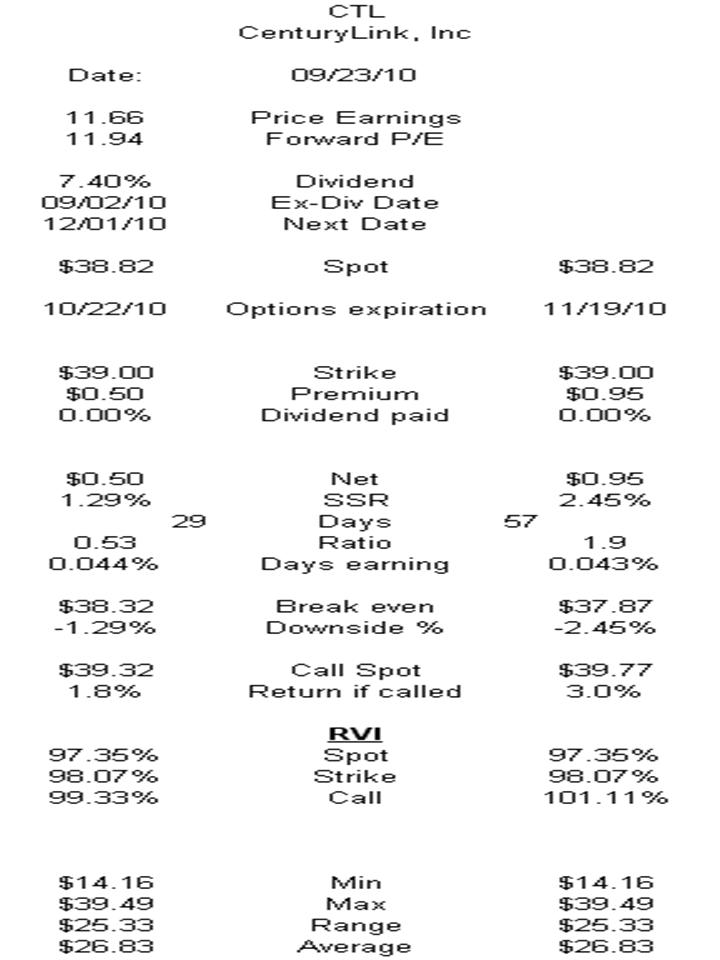
An article titled, "Goldman's 10 Stocks for Dividend Growth", written by David Hunkar and posted on Seekingalpha.com. We ran the stocks through our model, the results are below. For the most part we are familiar with these stocks. MMM was "my" stock in business school and one I have admired it ever since, guess I do love boring. Overall, the risk profile of most of the stocks looks good. We have previously posted analysis on ADI, BAX and CTL, see the dates listed adjacent on the stock listings.


*Note: the tables shown are embedded .jpg files. This means that you can: 1) double left click them with your mouse to enlarge them, or 2) right click them with your mouse and choose to open them in a new window or tab, print, save, etc.
As with everything we post, we may or may not have the stock and/or strategy in place in any one of our portfolios or may add it at any time.


ADI - Analog Devices, Inc (09/14/10) - Overall the metrics look good. There is little difference on the Oct v Nov calls and would opt for the Nov as it represents less trading and expense.


BAX - Baxter International, Inc - The P/E is a little high but the RVI's are low. The best value is in the near dated option, by 0.01%/day. Note the difference in the strike prices.


BMY - Bristol-Myers Squibb Company - Either date captures the dividend, the low P/E's are offset by the high RVI's. Like BAX, the daily difference in earning is 0.01%/day.


CTL - CenturyLink Inc (09/13/10) - Like BMY, the low P/E's are offset by the high RVI's. Although in this case the daily difference in earning is 0.001%/day.


HAS - Hasbro, Inc - Either date captures the dividend, the low P/E's are offset by the high RVI's. Like BAX, etc., the daily difference in earning is 0.011%/day. Note the different strike prices with the near date being "in the money".


HD - Home Depot, Inc - Either date captures the dividend. Even with a lower SSR, the near date offers the best return profile. The RVI's are fair all around.


KLAC - KLA-Tencor Corporation - The P/E is 26.72 while the RIV's are fair value..... The SSR's are great and either options covers the dividend with the near date earning a whopping 0.132%/day. The forward P/E is 8.5, but I'm struggling with the 26.72.


MMM - Minnesota Mining & Minerals - 3M Company - What is not to love about 3M? The RVI's are high, but either option covers the payment and the near date daily earning is 0.01% more than the far date.


T - AT&T (09/13/10) - We have an inherent fear of telco's although we did look at T on 9/13. The RVI's are high and the reward is limited with our strategy.