Monday, December 2, 2013

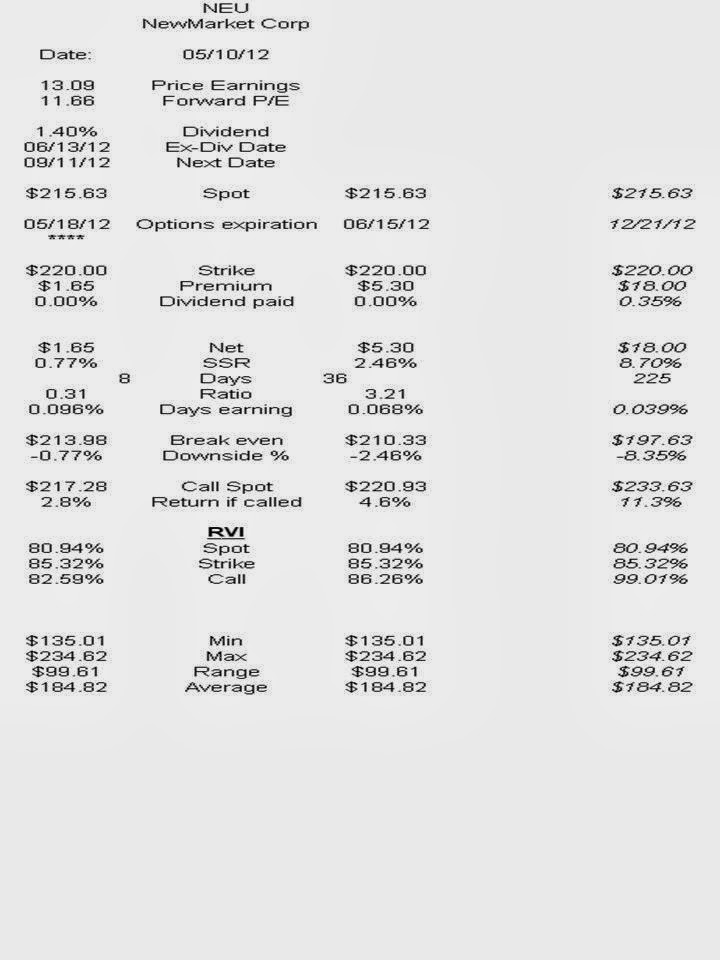
12/02/13 Into the year end

UPDATE Not really sure why I have not been able to get all the individual stock data loaned.  I know it has to do with a revised method of uploading the information.  I seem to be struggling as a blog/web master and for that I apologize..: 
However, I am excited about some of the stocks and their ranking.
For those of you who follow volatility, it is on the rise and that is helpful.
Of the stocks listed most of the top listed stocks on the ranking sheets (those other than the Alpha Sort) are quality investments and they have strong valuation as buy/writes.
Let me know via messaging if you need anything that has not posted.
For the week ending Thanksgiving we present our most recent analysis


:

List of this weeks current analysis in alphabetic order, reports below:
Symbol Name Dividend Pay Date
ADI Analog Devices, Inc 2.70% 11/28/13
ADP Automatic Data Processing, Inc. 2.40% 12/11/13
AEE Ameren Corporation 4.40% 12/09/13
AEO American Eagle Outfitters, Inc 3.10% 12/30/13
AGU Agrium, Inc 3.40% 12/26/13
ALB Albemarie Corporation 1.40% 12/11/13
APD Air Products & Chemicals Inc. 2.60% 12/30/13
ARG Airgas 1.70% 12/10/13
AUY Yamana Gold 2.90% 12/27/13
AXS Axis Holdings Limited 2.00% 12/27/13
BANF BancFirst Corporation – no options 2.20% 12/26/13
BAX Baxter International Inc 2.09% 12/04/13
BDX Becton, Dickinson and Company 1.80% 12/05/13
BEN Franklin Resources, Inc 0.70% 12/26/13
BXS BancorpSouth, Inc 0.80% 12/11/13
CAH Cardinal Health, Inc 1.90% 12/30/13
CB The Chubb Corporation 1.80% 12/19/12
CBU Community Bank System, Inc 4.00% 12/18/13
CCJ Cameco Corporation Common 1.90% 12/26/13
CIM Chimera Investment Group 12.00% 12/31/13
CNI Canadian National Railway Company 0.70% 12/06/13
EAT Brinker International, Inc. 2.00% 12/04/13
ECL Ecolab Inc 0.90% 12/13/13
EIX Edison International 2.90% 12/26/13
FGP Ferrellgas Partners LP 8.40% 12/04/13
FTR Frontier Communications Co 8.50% 12/05/13
GPC Genuine Parts Company 2.60% 12/04/13
HI Hillenbrand Inc Common Stock 2.70% 12/12/13
HPQ Hewlett-Packard Company 2.30% 12/09/13
HRB H&R Block, Inc. 2.80% 12/05/13
KMB Kimberly-Clark Corp Common 3.00% 12/04/13
KO The Coca-Cola Company Common 2.80% 11/27/13
LEG Leggety & Platt Inc 4.00% 12/11/13
MKC McCormick & Company 2.00% 01/03/14
MLR Miller Industries, Inc. Common * thin/illiquid options 3.00% 12/05/13
MO Altria Group Inc. 5.20% 12/12/13
MOS Mosaic Company 2.10% 12/03/13
MRK Merck & Co, Inc 3.50% 12/12/13
NUE Nuroc Corporation 3.90% 09/28/11
RAI Reynolds American Inc 5.00% 12/06/13
RBC Regal-Beloit Corporation 1.10% 12/24/13
RCI Rogers Communicatoins, Inc 3.70% 12/11/13
SCG SCANA Corp 4.30% 12/06/13
SDRL Seadrill Limited ORD 8.00% 12/05/13
STLD Steel Dynamics 2.40% 12/26/13
SYK Stryker Corporation Common 1.40% 12/26/13
TM Toyota Motor Corp. 2.00% 12/26/13
VAL The Valspar Corporation 1.40% 11/27/13
WMT Wal-Mart Stores, Inc 2.30% 12/04/13
WOR Worthington Industries, Inc 1.50% 12/11/13


11/28/13 Where have all the good times gone?

WOW - The last post of August produced a great result.  However, since then most of what we have been doing is working to keep our positions covered.  Not much in the way of analysis and therefore no need to post.  Posting nonsense on the internet does not require much skill and we like to think we offer skillful and worthwhile advice.

The market has been a climbing and we have worked to keep the delicate balance of chasing return as opposed to earning income.  We have written extensively about this polemic in the past and will refer you to those older posts.  This is a philosophical discussion but based in the service we offer our clients.  Chasing return is not our mandate and we provide a covered call service only because income is so hard to find.

With this in mind, I recall my rebuffed by an investment professional last year because I used a covered call strategy.  He managed a boutique investment house with a respectable AUM that serviced HNW individuals.  We were discussing the need to capture income and various strategies.  In his mind he could not separate income from capital gains.  After all, if you owned stocks the only reason was to earn capital gain.  As a former bond manager I understood his argument, however, he could not see the income component of covered call writing.  Do not misunderstand me, as the boutique manager seems to have, I am not and never have believed covered call writing is anything more than a transient strategy to generate "income" in an interest rate environment such as we have been in for the past several years.  This is a strategy to meet a need and is a direct result of the current market conditions.

Previously, portfolio managers could rely on corporate bonds, preferred stocks, etc.  These asset classes are few and far between these days.  My research of more than a decade ago demonstrated a strong correlation between corporate equity and fixed-income with the junction where preferred and convertible securities meet.  Needless to say must companies never offered this spectrum within their capital structure.  These days, the nature of financing has changed as capital markets are adjusting to the demands of fiscal, monetary and taxation policy.

Anyway, to return to my boutique manager, he is old enough to remember the glory days of coupon bonds and respectable opportunities to create income for clients.  He just could not come to terms with covered calls on high yielding stocks.  Synthetic income does not work.  I understand but refuse to wear a scarlet A or rather I (for income).

Friday, August 2, 2013

08/02/13 - It is summer and the living is easy

George Gershwin did have a way with words.  Where have the simpler times gone?


There was a time when we did not worry about the market, there was no CNN and the internet had not been invented. That is not the time we now live in no matter how hard I try.  In the past few months most of the trading we have done was to hedge, write calls against, existing positions.  The market has continued its gravity defying climb ever higher.
As we have previously written, we have no comfort in chasing the market.  Our goal is to add income not principle value.  The past 6 months have been challenging as we do not want to get whipped-sawed (buying high just to participate then selling low because we get stopped out at a loss).
Corporate cash continues to accumulate.

 http://www.stlouisfed.org/publications/re/2013/a/images/FIG1_CASHL.pngSource: Compustat

Ratio of Cash to Net Assets


Ratio of Cash to Net Assets Source: Compustat

The Ratio chart seems to be most indicative although both charts demonstrate that cash holdings are high for the past decade.  This is important information and a clear reason for the strength of the market.  The article authors determine that, "There are two main reasons why firms find it beneficial to hold cash: precautionary motive and repatriation taxes."  Precautionary motive...... fear of the future.  The business and political environment globally is unstable at best.  Corporations are risk taking and adventurous organizations.  They profit from taking risks.  When they curtail their activities the economy suffers.  If cash is truly the grease that lubricated the rails of the economy, then hording cash is a sign of coming problems, as if there are not enough problems now.  The tax issue is a constant.  The primary goals of any corporation is to make money and avoid paying taxes on the profits.  When both are done legally investors cheer, when done illegally government investigators and prosecutors cheer (job security).
Why have stock prices risen with corporate cash holdings?   Investors buy stocks for appreciation, income and ownership.  There are any number of theories as to how stock prices are arrived at and what constitutes the value of a stock at any given moment.  Present value of future earnings, discount dividend, and my personal favorite the equilibrium between buyers and sellers.  Cash can easily be disgorged by managers in the form of investment, wages, bonuses and dividends.  Investment can be in the form of buying property plant and equipment or another firm.  The 1980's saw diversification as a means of growth.  This had mixed results.  Integration can be good as ling as it is within the confines of the existing business.  There is one aviation company that owns a guitar maker, but that is the exception.  Tyco did a good job of adding annuity based service companies while RJR didn't do such a good job adding businesses to its portfolio.  GE remains to be seen, our group is split on that one.  However, with stock prices so high, it is logical to assume valuations are too high as well.  If so buying a company may be too expensive.  Paying higher wages and bonuses will be frowned upon, however, providing better benefits or funding pension obligations will be more acceptable.  Paying of dividends, special dividends especially, is a time honored tradition that income investors really, really like.  Although we are not betting on a tsunami of special dividends, we have seen some and would welcome more.  If the choice were greater taxation of corporate cash or rewarding shareholders, we would like the latter.  Note that there is a tax payment necessary for every dividend at the corporate level (remember the triple taxation arugement on dividends?).  Certainly, acquiring businesses' is a good idea, valuations and an uncertain economy may leave managers little choice but to provide special dividends.